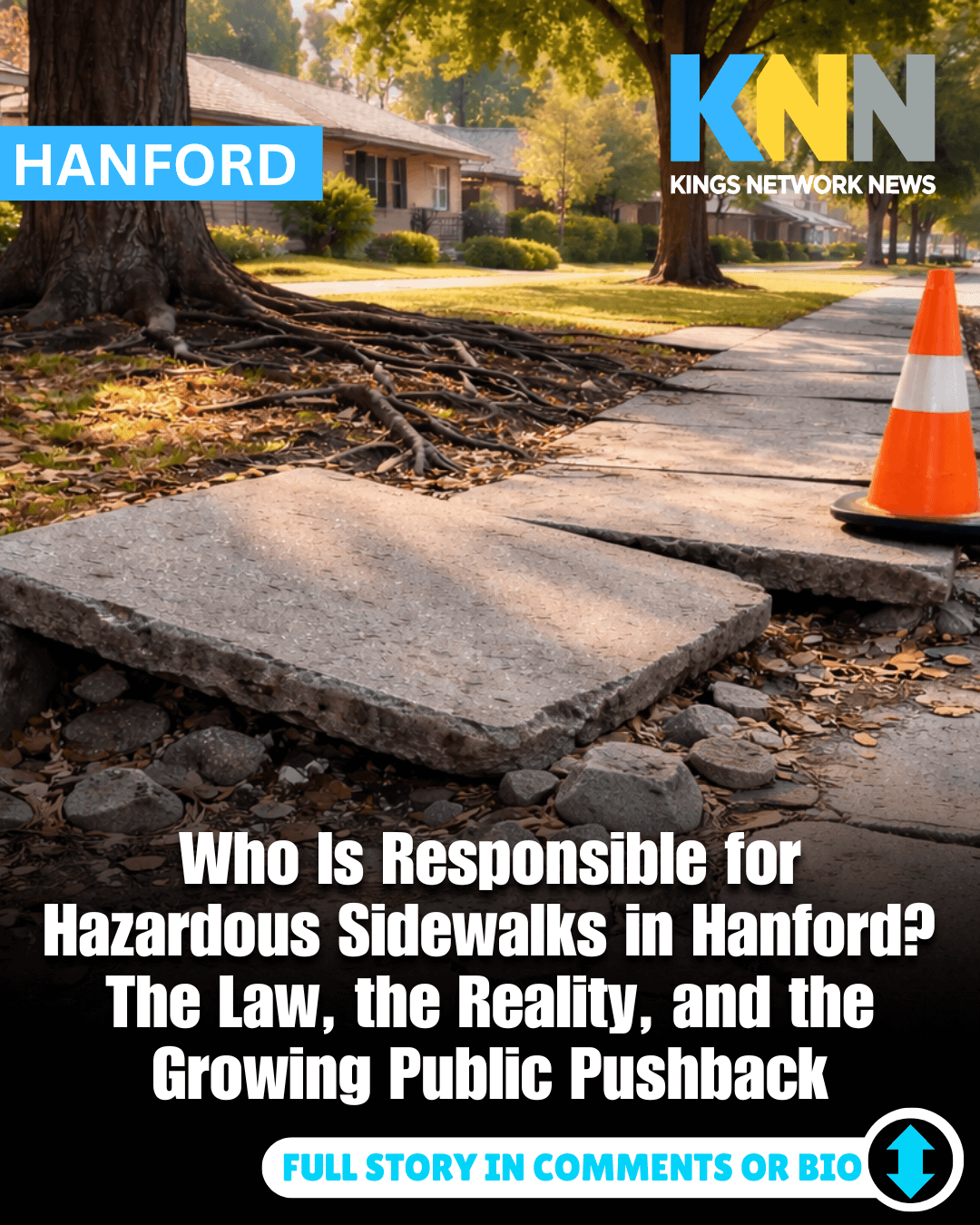


In neighborhoods across Hanford, cracked, lifted, and sunken sidewalks are a familiar sight. Tree roots push concrete upward, age causes slabs to sink, and years of wear create tripping hazards that concern residents, parents, seniors, and people with disabilities. When a sidewalk becomes dangerous, many residents assume the City is responsible for repairs. Under California law and Hanford’s municipal code, the answer is far more complicated, and for many homeowners, surprising.
At the center of the issue is a long standing legal framework that places sidewalk maintenance responsibility not on the City, but on adjacent property owners. As residents raise concerns, compare Hanford to other cities, and question fairness, a broader conversation is emerging about responsibility, liability, and whether local policy aligns with modern public expectations.
This article examines the City of Hanford’s stated position, the legal basis behind it, extensive resident reactions, insight from a former Central Valley city councilmember, and how Hanford compares to other California cities that take a very different approach. It also explores the gap between law on the books and how cities actually enforce sidewalk repair obligations.
The City of Hanford’s Official Position
According to the City of Hanford, responsibility for maintaining public sidewalks rests with the owners of properties adjacent to those sidewalks. This position is grounded in both state law and local municipal code.

Since 1941, the California Streets and Highways Code has allowed cities to assign sidewalk maintenance duties to adjacent property owners. Hanford has codified this responsibility through Municipal Code Chapter 12.20.
The code states:
“Except as otherwise provided in this chapter, an owner of a lot or portion of a lot adjacent to or fronting any portion of a sidewalk area or on which a sidewalk area is located shall maintain and repair the sidewalk so that it remains a safe and non-dangerous condition at his, her, or its sole cost and expense.”
In plain terms, the City’s position is that sidewalks may be public right of way, but the duty to maintain them belongs to the adjacent homeowner.
The City also encourages residents to report sidewalk hazards through the My Hanford app or web portal. Officials state that reporting helps identify unsafe conditions and begins the process of addressing them.
For many residents, however, that message translated to this: report a problem, then prepare to pay for it yourself.
Why This Law Exists, and Why That Alone Does Not Settle the Issue
Sidewalk responsibility laws date back decades and were originally designed to reduce municipal costs during a time when cities had far fewer infrastructure obligations.
Courts have generally upheld these laws, confirming that cities may delegate maintenance responsibility while retaining control over public right of way.
However, legal authority does not require uniform enforcement, and this is where Hanford increasingly stands out.
Across California, cities have adopted widely different practices despite similar legal authority. The presence of a statute does not dictate how aggressively it must be enforced, nor whether cities should absorb costs, share them, or manage repairs directly.
Resident Reactions: “If I Can’t Fence It, It’s Not Mine”
As the City emphasized its legal position, residents responded forcefully.
James Vale captured a core concern:
“If I can’t fence it in, it’s not mine, nor should it be the homeowner’s responsibility.”
This sentiment was echoed repeatedly. Residents pointed out that they cannot restrict access, modify sidewalks without permits, or remove city approved trees that often cause the damage.
Jamie Medina wrote:
“Sidewalk = public property. Public = the city.”
Lizzie Vecchio added:
“If it ain’t on my deed it most definitely should be the City’s responsibility.”
For many homeowners, the issue is not simply cost. It is liability, control, and being held responsible for infrastructure they neither own nor manage.
Public Outrage: What Residents Are Actually Saying
The public response to the City’s explanation was overwhelmingly negative.
Pamela Preston-Muncy wrote:
“City won’t take responsibility. They’ll tell you they have no money to fix anything.”
Larry Vargas questioned the logic entirely:
“We pay property taxes to avoid this. You the city builds sidewalks. You the city are responsible. Who cares what codes you write.”
Faith Lewright challenged the age of the law itself:
“Well that needs to be updated because it’s not 1941.”
Jason Lopez accused the City of enforcement without service:
“Report the cracked sidewalks so the city can do the only thing they know how, write you a citation.”
These comments reveal not confusion, but anger rooted in feeling blindsided.
Property Taxes, Costs, and Financial Reality
Many residents tied sidewalk responsibility directly to taxes.
Raider Raul wrote:
“$400 a month I pay for property taxes this should be covered.”
Bryan Suits questioned the logic:
“So I pay property tax… but I have to replace a sidewalk in front of my house if it’s a trip hazard?”
Residents expressed concern that sidewalk repairs can cost thousands of dollars, particularly when multiple slabs or tree root damage is involved. Seniors and fixed income homeowners were repeatedly mentioned as being especially vulnerable.
Trees, City Control, and Conflicting Rules
A major source of outrage involved city approved trees.
Matt Quinn summarized the contradiction:
“Sidewalks are your problem and so are the trees, but you can’t remove them… and you have to plant approved ones.”
Paula Noga questioned enforcement fairness:
“If the homeowner has to make the repairs and that entails cutting down the tree, will the homeowner be fined for that?”
Julius Barr was blunt:
“If the owner fixes it and removes the darn tree that caused all the damage, the city will fine you.”
This dynamic left many residents feeling trapped between responsibility and restriction.
California Cities That Do Not Enforce Sidewalk Repairs This Way
This is where Hanford diverges sharply from many other California cities.
Former Fresno City Councilmember Tom Bohigian stated:
“We never foisted repairs on homeowners unless they somehow damaged the sidewalk, which rarely happened.”
Large California cities including Los Angeles, San Francisco, San Diego, and Sacramento all operate city managed sidewalk repair programs, even though they possess the same legal authority Hanford cites.
Los Angeles operates the Safe Sidewalks LA program, a city funded initiative that repairs damaged sidewalks across neighborhoods, prioritizing accessibility and public safety.
San Francisco funds sidewalk repairs through its public works department, handling most repairs directly rather than billing homeowners.
San Diego historically manages sidewalk repairs as part of its capital improvement and infrastructure maintenance programs.
These cities recognize sidewalks as core public infrastructure, similar to roads and storm drains, and treat maintenance as a municipal responsibility rather than an individual burden.
Hanford’s approach, while legal, is not the norm in California.
Communication Breakdown: Why the Meme Made It Worse
Beyond policy, residents strongly criticized how the message was delivered.
Susan Davis wrote:
“Using a Spider-Man meme to deliver a serious, costly notice to homeowners is immature and unprofessional.”
For many residents, the meme trivialized what they view as a serious financial and legal issue. Instead of clarity, it created resentment.
When government communication appears dismissive or casual about costs imposed on residents, trust erodes quickly.
Law Versus Practice: The Real Issue
Mike Cosenza stated:
“Up until a few years ago, the City fixed ALL sidewalks.”
Whether fully accurate or not, this belief highlights a perception that enforcement has changed without transparency.
The issue is no longer just about what the law allows. It is about how it is applied, explained, and justified.
The Bigger Picture
Sidewalks may seem minor, but they reveal how a city views its role in maintaining shared public spaces.
When residents feel policies are outdated, unevenly enforced, and poorly communicated, frustration grows.
Hanford is legally permitted to enforce this policy. But compared to how most California cities handle sidewalk maintenance, it stands increasingly alone.
Conclusion
Under California law and Hanford Municipal Code, adjacent property owners are legally responsible for sidewalk maintenance. That is not disputed.
What is disputed is whether enforcing that responsibility without meaningful city participation, financial assistance, or clear communication reflects modern standards of public infrastructure management.
The volume and intensity of resident reaction show this issue is no longer about concrete. It is about trust, fairness, and whether City Hall is listening.
In Hanford, the sidewalk debate has become a defining community conversation, and one that is only beginning.
Discussions are powered by Facebook. Community standards apply. Comments attacking Kings Network News, its publisher, staff, or contributors may be removed and may result in loss of access.

Francisco Ramirez is the founder of Kings Network News and creator of Kings Network Business, a platform that blends business networking, community support, and social media to uplift local entrepreneurs.
As a former Mayor of Hanford, California, he launched the Winter Wonderland event and brings over 20 years of business consulting experience. He is also a motivational speaker, life coach, strategist, author, podcaster, and skilled web and graphic designer.
He created The Invisible Kid: Courage to Succeed, a seminar on self-esteem and anti-bullying that has inspired youth across the region. Through media and consulting, Francisco empowers others to lead, grow, and make an impact.