

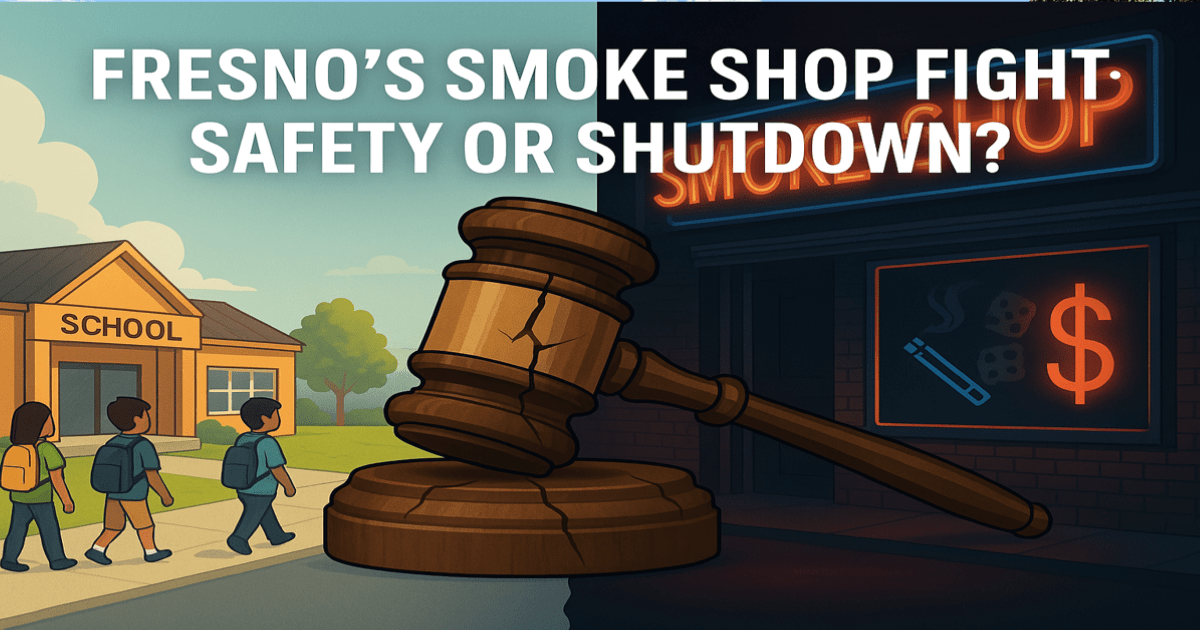
FRESNO, CA – On March 13, 2025, the Fresno City Council chambers buzzed with a heated debate over a proposed ordinance aimed at regulating the city’s smoke shops. The discussion, which stretched over hours and included passionate public testimony, revealed deep divisions among council members and the community. Two weeks later, as the dust settles, the ordinance’s failure to pass—with a 3-3 vote—leaves Fresno at a crossroads on how to address the proliferation of smoke shops and their associated challenges.
The ordinance sought to define smoke shops, currently classified as general retail businesses, and impose stricter regulations akin to those governing alcohol and cannabis outlets. Key provisions included requiring conditional use permits (CUPs), establishing 1,000-foot buffer zones from sensitive areas like schools and parks, and setting clear guidelines on permissible products and operating hours. Proponents argued it would curb illegal activities—such as drug sales, gambling, and gun possession—linked to some of the city’s 140+ smoke shops, particularly concentrated in southern Fresno.
Council Vice President Miguel Arias, a co-sponsor alongside Councilmembers Annalisa Perea and Luis Esparza, emphasized the ordinance’s intent to protect neighborhoods. “It took me two years for one smoke shop to be shut down,” Arias said, referencing a resource-intensive effort in his district. With 47 smoke shops in his area alone, he argued that existing tools—like nuisance laws and landlord evictions—are insufficient against widespread saturation. “It’s unfair to suggest we can shut down all the bad actors with the resources we have,” he added, noting a looming $15-20 million city deficit and expiring state enforcement grants.
Public input mirrored the council’s divide. Smoke shop owners, like Sam Assuman, pleaded for reconsideration, highlighting economic fallout: “You’re talking about a loss of $1.9 million in payroll taxes, $4 to $6 million in sales tax yearly.” They warned of job losses—potentially hundreds—and a potential black market surge, citing vaping bans as precedent. Conversely, public health advocates, including Abel Arevalo of the Fresno County Tobacco Free Coalition, pushed for a Tobacco Retail License (TRL) policy, an evidence-based approach adopted by over 230 California jurisdictions to reduce illegal tobacco sales and protect youth.

The council grappled with balancing these concerns. Councilmember Tyler Maxwell proposed amendments, including allowing CBD sales and grandfathering existing shops not committing “egregious violations”—defined as illegal drug activity, sales to minors, prostitution, or gambling. Councilmember Nelson Esparza VI suggested an educational program for shop owners, while Councilmember Mike Carbajal questioned the fairness of punishing legitimate businesses alongside bad actors. “This could be a shotgun to a problem that needs a sniper rifle,” Carbajal warned, citing a successful shutdown in Pinedale using current tools.
The debate over “egregious violations” sparked confusion. An initial broad list included loitering and public urination—prompting Carbajal to ask, “How is the business responsible for someone else’s behavior?” A narrower definition in the ordinance text focused on direct illegal activities, but ambiguity lingered, fueling concerns about subjective enforcement.
Amendments piled up: CBD sales and education were accepted, but grandfathering stalled. Perea worried it would lock in bad actors among the 82 licensed shops, while Maxwell’s push for district-specific flexibility—allowing council members to cap future permits after natural attrition—gained traction but lacked time for legal vetting. “I’m hungry for change,” Arias quipped, rejecting a delay despite Carbajal’s plea to refine the policy at the next meeting.
The final vote split the council: Arias, Perea, and Esparza voted aye; Maxwell, Richardson, and Carbajal nay. With Mayor Jerry P. Dyer absent, the motion failed 3-3. “Robust democracy,” Carbajal called it, praising the public process but lamenting unresolved tensions.
As of March 28, the ordinance’s fate remains uncertain. The council’s next meeting could revisit it, but the clock ticks on addressing smoke shop saturation. For now, Fresno’s neighborhoods—and its small business owners—await a solution that balances safety, health, and economic equity. Will it be a scalpel or a sledgehammer? Only time, and perhaps a unanimous vote, will tell.


Join the Conversation
Join the Conversation
Log in with Google, Facebook, or your WordPress account to leave a comment.
Support KNN
Choose your support amount
Enjoying local news? Support King's Network News and help keep independent community coverage moving forward.
Donate with Cash AppSupport KNN local news
Prefer to scan? Use the Cash App QR code below.

Francisco Ramirez

Francisco Ramirez Jr. is the founder of Kings Network News and creator of Kings Network Business, a platform focused on community engagement, local business support, and digital media innovation across California’s Central Valley.
A former Mayor of Hanford, California, Ramirez launched the popular Winter Wonderland event and brings more than 20 years of experience in business consulting, media strategy, marketing, and entrepreneurship. He is also a motivational speaker, strategist, author, podcaster, and experienced web and graphic designer.
Ramirez created The Invisible Kid: Courage to Succeed, an anti-bullying and self-esteem seminar that has inspired youth throughout the region. Through journalism, consulting, and community-driven projects, he continues working to inform, inspire, and empower others to grow, lead, and make a positive impact.










Join the conversation
Share your thoughts on this story.
Be the first to share your thoughts on this story.