

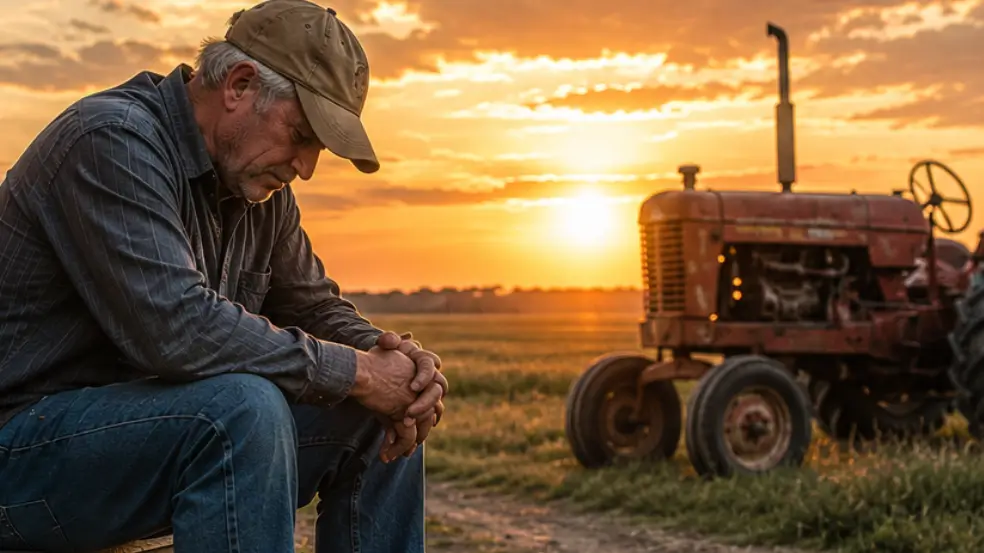
For generations, America’s farmers have represented resilience, perseverance, and hard work. They work long hours, battle droughts, floods, rising costs, and unpredictable markets, all while producing the food that feeds our nation.
Yet behind that image lies a growing mental health crisis that many Americans rarely hear about.
According to a comprehensive review of available research, there is still no single national database capable of accurately tracking how many U.S. farmers and farmworkers die by suicide each year. The strongest available analysis identified 3,410 farmer and farmworker suicides between 2014 and 2021, although researchers emphasize that this figure almost certainly underestimates the true toll because of inconsistent reporting systems and varying definitions of who qualifies as a farmer or farmworker.

A Hidden Crisis
Unlike many occupations, agriculture presents unique challenges when tracking suicide deaths.
Death certificates often record only a person’s “usual occupation,” meaning retired farmers, seasonal workers, family members working on farms, or individuals with multiple occupations may not be counted as agricultural workers. Researchers also note there is no nationwide surveillance system consistently capturing these deaths under one standardized methodology.

Because of these limitations, experts believe the actual number of farmer and farmworker suicides over the past decade is likely higher than current public statistics suggest.
Research has consistently found that agriculture remains one of the occupations with elevated suicide risk in the United States.
A 2021 occupational mortality analysis found:
- Farmers, ranchers, and agricultural managers experienced a male suicide rate of 52.1 per 100,000 workers.
- Miscellaneous agricultural workers experienced 38.1 suicides per 100,000.
- The average across all male occupations was 32.0 per 100,000.
Who Is Most Affected?
The available research shows several common characteristics.
Most farmer suicide victims are male, White, and middle-aged or older. Some studies found nearly 90 percent of farmer suicide victims were men, while other research indicates suicide rates are especially high among farmers age 65 and older.
Researchers say multiple factors contribute to the crisis, including financial stress, declining commodity prices, rising debt, physical health challenges, isolation, family pressures, limited access to mental health care, and easy access to firearms.
The Conversation That Inspired This Story
Last night, I had the opportunity to attend a meeting of the 1776 Sons of Liberty in Hanford.
The discussion covered a variety of important issues, including the conflict involving Iran, Flock safety cameras, California water policy, and proposed data centers. While opinions differed throughout the evening, what impressed me most was how respectful and thoughtful the conversation remained. Although the organization is Republican in its orientation, I found the discussion to be logical, civil, and centered on exchanging ideas rather than simply arguing. Regardless of your political affiliation, I would encourage people to attend one of their meetings and hear the conversations for themselves.
After the meeting, I spoke with a gentleman who I estimate was around 80 years old. We talked for approximately 10 to 15 minutes.
He spoke passionately about California’s water challenges, concerns over water flowing to the ocean while farmers struggle, and what he believes are policies that have made life increasingly difficult for those working in agriculture.
Then he said something that stayed with me.
He told me about the high rate of suicide among farmers.
That single conversation inspired me to research the issue more deeply. The more I read, the more I realized this wasn’t simply an isolated concern. The research consistently shows that America’s farming community faces one of the highest occupational suicide risks in the country.
I look forward to sitting down with him for a future interview to hear more of his experiences and perspectives.
My Perspective
As someone who has spoken with countless members of our community over the years, I believe many Americans misunderstand what today’s farmers face.
Some assume farmers receive large subsidies or make significant profits. For many family farmers, that simply isn’t their reality.
Equipment costs continue to rise. Fuel costs fluctuate. Labor grows more expensive. Regulations become increasingly complex. Yet many American farmers must sell into a global marketplace where they compete against producers in countries that often operate under different labor standards, environmental regulations, and production costs.
In my opinion, that makes it increasingly difficult for family farms to remain profitable.
I also believe America has become far more dependent on imported goods over the past several decades. Whether people agree with that assessment or not, it raises an important question: what happens if we continue losing independent family farms?
Food security is national security.
Personally, I worry about a future where fewer independent farmers remain, more agricultural production becomes concentrated in fewer hands, and our nation becomes increasingly dependent on outside sources for the food we eat.
I also believe we should continue having thoughtful discussions about issues such as water policy, seed preservation, sustainable agriculture, and the long-term future of American farming. Regardless of political affiliation, these conversations affect every American because every American depends on farmers.
The statistics tell us this is more than an economic issue.
It’s a human issue.
Behind every number is someone’s father, mother, grandfather, grandmother, son, daughter, neighbor, or lifelong friend.
No farmer should ever feel that financial hardship, isolation, or overwhelming stress leaves them with no hope.
If this article encourages even one person to reach out to a struggling farmer, check on a neighbor, or start an important conversation about mental health, then sharing this story will have been worthwhile.
America’s farmers feed this country.
Perhaps it’s time we do more to make sure they’re cared for, too.

Join the Conversation
Join the Conversation
Log in with Google, Facebook, or your WordPress account to leave a comment.
Support KNN
Choose your support amount
Enjoying local news? Support King's Network News and help keep independent community coverage moving forward.
Donate with Cash AppSupport KNN local news
Prefer to scan? Use the Cash App QR code below.


Francisco Ramirez

Francisco Ramirez Jr. is the founder of Kings Network News and creator of Kings Network Business, a platform focused on community engagement, local business support, and digital media innovation across California’s Central Valley.
A former Mayor of Hanford, California, Ramirez launched the popular Winter Wonderland event and brings more than 20 years of experience in business consulting, media strategy, marketing, and entrepreneurship. He is also a motivational speaker, strategist, author, podcaster, and experienced web and graphic designer.
Ramirez created The Invisible Kid: Courage to Succeed, an anti-bullying and self-esteem seminar that has inspired youth throughout the region. Through journalism, consulting, and community-driven projects, he continues working to inform, inspire, and empower others to grow, lead, and make a positive impact.









Join the conversation
Share your thoughts on this story.
Be the first to share your thoughts on this story.