

California is an agricultural powerhouse, producing almonds, pistachios and other crops consumed around the world. But as our state struggles with groundwater supplies, perhaps we need to ask a bigger question: How much California water are we effectively exporting with our crops?
Consider the almond.
A commonly cited estimate suggests it takes about one gallon of water to produce a single almond, although the amount varies depending on rainfall, location, irrigation practices and how the water footprint is calculated.
Now picture that.

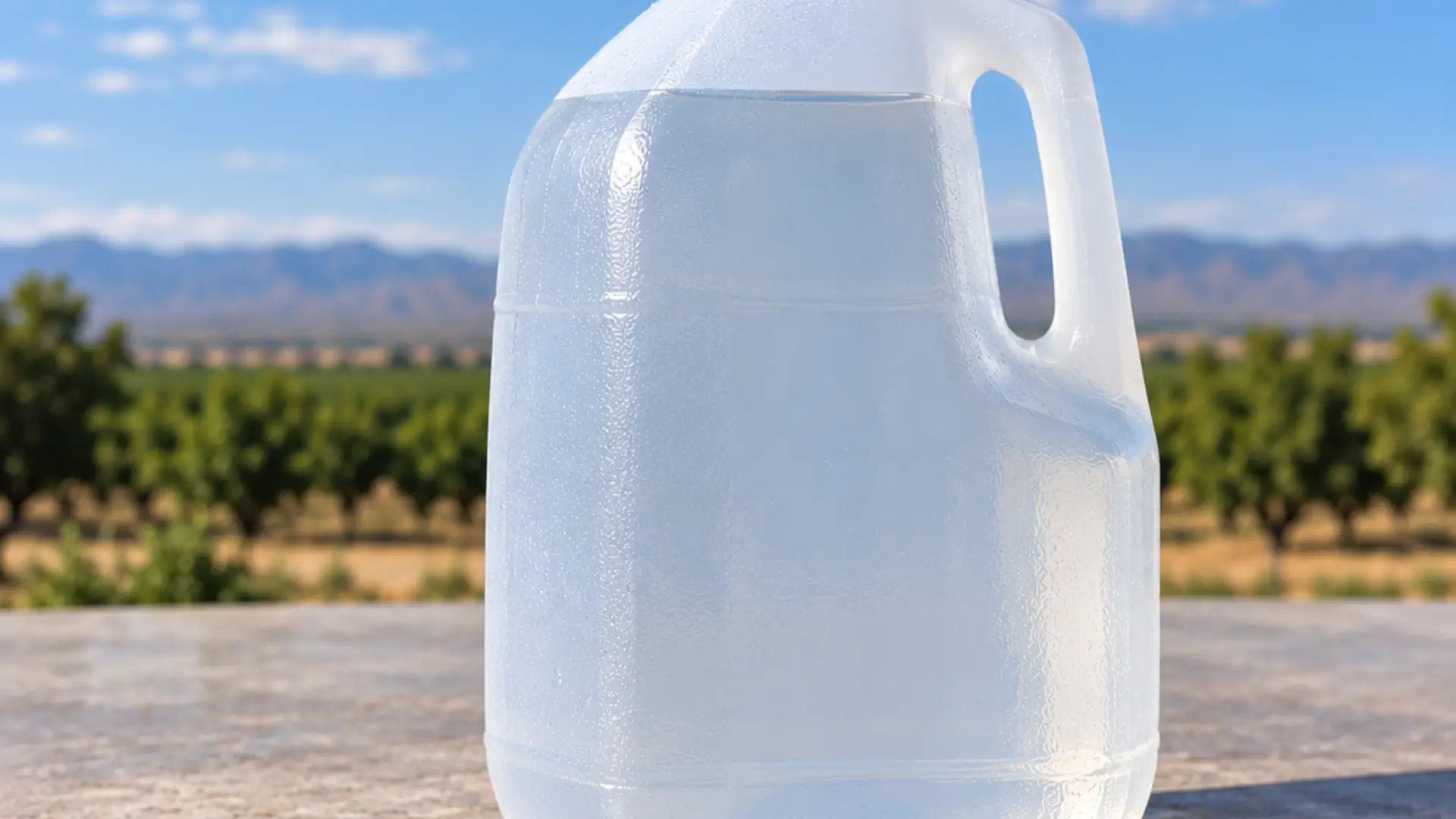
Place one ordinary almond next to a one-gallon jug of water. That gallon represents roughly how much water may be associated with producing that tiny almond under the commonly cited estimate.
Now consider almond milk. A standard carton contains 64 fluid ounces, or half a gallon. Commercial almond milk varies considerably in almond content, but if a carton contains the equivalent of roughly 50 to 100 almonds, growing those almonds could represent approximately 50 to 100 gallons of water using the one-gallon-per-almond estimate.
That’s roughly enough water to fill a standard bathtub, all to produce the almonds contained in a half-gallon carton.
Why Are We Exporting So Much?
California also produces enormous quantities of pistachios, another permanent tree crop requiring irrigation year after year. Significant amounts of both almonds and pistachios are exported overseas.

That raises another question we should be willing to ask.
Could part of the attraction of importing California-grown crops be that importing countries get the product without having to use the same amount of their own agricultural land and water to produce it?
We shouldn’t claim that countries such as China or India specifically purchase California almonds to protect their water supplies without evidence showing that motivation. But the economic concept is real. When California water is used to grow a crop that is exported, the importing country receives the agricultural product while the water required to grow it was consumed here.
This is known as “virtual water.”
Perhaps California should start thinking about that equation differently.
If we’re asking residents to conserve water and farmers to reduce groundwater pumping, should we continue expanding water-intensive permanent crops, particularly when substantial portions of those crops are destined for overseas markets?
This isn’t about blaming farmers. Agriculture provides jobs, supports Central Valley communities and feeds people around the world.
It’s about asking whether California can farm smarter.
Maybe we should encourage crops that provide greater economic and nutritional value for every gallon consumed, particularly in areas where groundwater is declining.
We measure agriculture by dollars per acre. Perhaps it’s time we also measure it by value per gallon of California water.

Join the Conversation
Join the Conversation
Log in with Google, Facebook, or your WordPress account to leave a comment.
Support KNN
Choose your support amount
Enjoying local news? Support King's Network News and help keep independent community coverage moving forward.
Donate with Cash AppSupport KNN local news
Prefer to scan? Use the Cash App QR code below.


Francisco Ramirez

Francisco Ramirez Jr. is the founder of Kings Network News and creator of Kings Network Business, a platform focused on community engagement, local business support, and digital media innovation across California’s Central Valley.
A former Mayor of Hanford, California, Ramirez launched the popular Winter Wonderland event and brings more than 20 years of experience in business consulting, media strategy, marketing, and entrepreneurship. He is also a motivational speaker, strategist, author, podcaster, and experienced web and graphic designer.
Ramirez created The Invisible Kid: Courage to Succeed, an anti-bullying and self-esteem seminar that has inspired youth throughout the region. Through journalism, consulting, and community-driven projects, he continues working to inform, inspire, and empower others to grow, lead, and make a positive impact.










Join the conversation
Share your thoughts on this story.
Be the first to share your thoughts on this story.