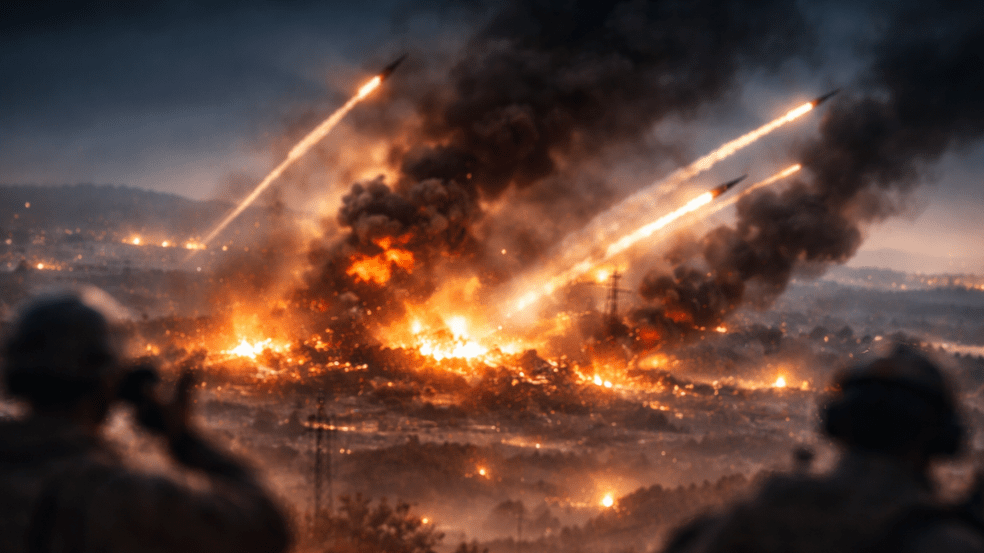

The growing conflict involving Iran is expanding beyond its original scope, with more countries becoming entangled in the situation as tensions escalate across the Middle East and parts of Europe.
What began as a confrontation involving a small number of nations has now spread to at least 13 countries connected to the conflict or its fallout. Among the nations now affected are the United Arab Emirates, United Kingdom, Saudi Arabia, Lebanon, Cyprus, Bahrain, Qatar, Syria, Oman, Jordan, Kuwait, Yemen, and Iraq.
One of the most significant developments came after Iran reportedly struck United Kingdom military facilities located in Cyprus, marking the first time the conflict has directly touched territory tied to Europe. Cyprus is a member of the European Union, prompting political leaders there to call for a unified response from the EU.
A member of the European Parliament representing Cyprus said the attack should be treated seriously by European nations, noting that an assault on one member state could be interpreted as an attack on the broader European Union.

In response to the escalation, the United Kingdom has authorized the United States to use its military bases to assist in targeting Iran’s missile systems, signaling increased coordination between Western allies.
The conflict has also spread across the Middle East. Lebanon has entered the situation after Hezbollah launched strikes against Israel in what officials described as support for Iran. Meanwhile, energy infrastructure in the Gulf region has been affected.
Saudi Arabia and Qatar both experienced disruptions to major energy facilities, including fires and operational shutdowns. Qatar, which supplies roughly 20 percent of the world’s liquefied natural gas, temporarily suspended some operations, raising concerns about potential impacts on global energy markets.
International organizations are also monitoring the situation closely. NATO officials have described Iran as a growing threat to Europe, Israel, and the wider region, though the alliance has indicated that the current military actions are primarily being led by the United States and Israel rather than NATO itself.
For now, NATO has not formally entered the conflict, but officials say the situation is evolving rapidly.
As tensions continue to develop, analysts warn the involvement of additional countries could further expand the geopolitical impact of the conflict and increase pressure on international alliances to respond.

Discussions are powered by Facebook. Community standards apply. Comments attacking Kings Network News, its publisher, staff, or contributors may be removed and may result in loss of access.

Francisco Ramirez is the founder of Kings Network News and creator of Kings Network Business, a platform that blends business networking, community support, and social media to uplift local entrepreneurs.
As a former Mayor of Hanford, California, he launched the Winter Wonderland event and brings over 20 years of business consulting experience. He is also a motivational speaker, life coach, strategist, author, podcaster, and skilled web and graphic designer.
He created The Invisible Kid: Courage to Succeed, a seminar on self-esteem and anti-bullying that has inspired youth across the region. Through media and consulting, Francisco empowers others to lead, grow, and make an impact.