
Looking at the Numbers
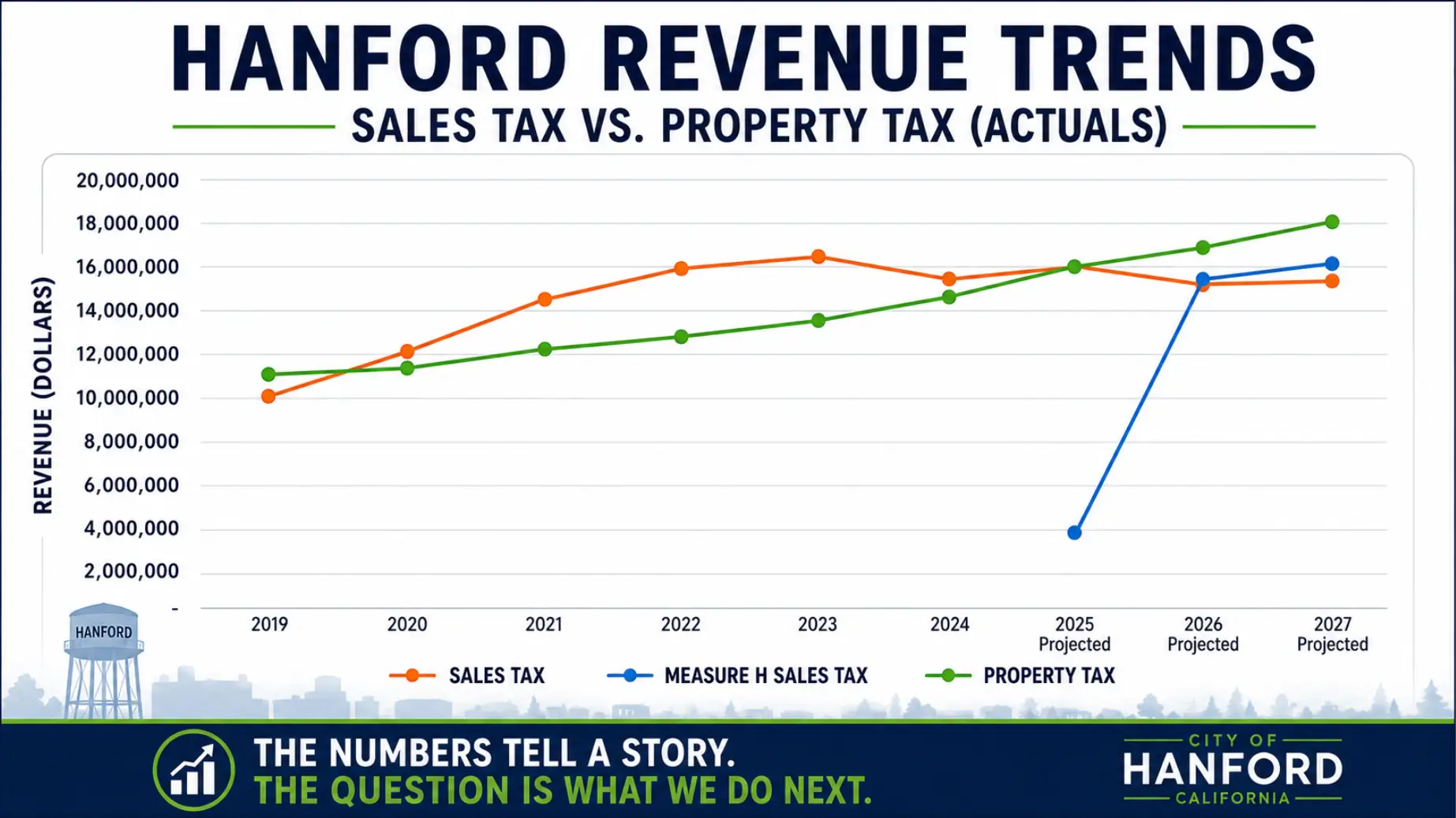
Looking at these numbers, I’m concerned. Yes, revenues are going up, but sales tax revenue appears to be slowing down and flattening out. To me, that is a warning sign.
During my time as Mayor in 2021, the City of Hanford focused on creating a more business-friendly environment. We worked to streamline processes, implement new technology, reduce barriers where possible, reduce and combine service fees, and improve the way residents and businesses interacted with City Hall.
This was not the work of one person. It was accomplished with the help of the City Council I had the privilege of serving alongside, a group of business-minded individuals who understood the importance of economic growth, efficiency, and creating an environment where businesses could succeed.
While no single administration can take sole credit for economic growth, many economists recognize that the benefits of policy decisions are often realized years later. The strong revenue growth seen between 2019 and 2023 did not happen overnight. It was the result of decisions, investments, and long-term planning made by many people working together to move Hanford forward.

Some may say the economy is bad, but look at the numbers. In 2021, when COVID was still heavily impacting businesses and families, Hanford still saw strong sales tax revenue growth. So blaming the economy only goes so far.
What concerns me today is that sales tax revenue, which reflects local economic activity, appears to be leveling off. Instead of seeing continued growth from new businesses, new jobs, and new investment, the city appears to be becoming more dependent on Measure H revenue and property tax revenue.
That is not how you build a strong local economy. You cannot tax your way into prosperity. A healthy economy comes from attracting businesses, supporting entrepreneurs, investing in infrastructure, and creating an environment where businesses want to open, expand, and hire.
The numbers do not lie. Sales tax was growing strongly around 2021, but now it appears to be flatlining. The question is simple: are we creating real economic growth, or are we becoming more dependent on taxes to make up the difference?

Hanford has proven that growth is possible, even during difficult times. The challenge now is ensuring that future growth comes from a stronger local economy, not simply from asking residents and property owners to carry more of the burden.
Accumulated Capital Outlay Fund Drops Sharply Since 2021
Another major concern in the budget discussion is the condition of the City’s Accumulated Capital Outlay Fund, commonly known as the ACO Fund.
The ACO Fund helps pay for major capital projects, infrastructure improvements, large facility repairs, and other one-time city investments. In simple terms, it serves as one of the city’s key funding sources for long-term community improvements.
According to city budget documents, the Capital Projects Fund, where the ACO Fund was reported, had an ending balance of approximately $4.57 million in Fiscal Year 2020-21. Under the current budget outlook, the ACO Fund is projected to decline to approximately $230,000 by the end of Fiscal Year 2027.
That represents a reduction of more than $4.3 million from its 2021 level.
The approved budget also includes $900,000 from the ACO Fund for the City Hall roof replacement, leaving only about $230,000 remaining after planned FY27 projects.
For residents, this matters because the ACO Fund has historically provided flexibility for major repairs, infrastructure investments, and unexpected capital needs. As that balance declines, the city may have fewer available resources to address future projects without identifying alternative funding sources.
When I look at the sales tax projections and then look at the condition of the ACO Fund, I become even more concerned. If sales tax growth is flattening and one of the city’s key capital project funding sources is projected to fall from more than $4.5 million to roughly $230,000, residents should be asking questions about the long-term financial direction of the city.
For years, Hanford benefited from strong economic growth. Revenue growth gave the city opportunities to invest in infrastructure, maintain services, and prepare for future needs. The purpose of good financial management is not simply to get through the next budget year. It is to prepare for the next decade.
A reserve fund like the ACO Fund provides flexibility. It gives a city the ability to respond to major repairs, facility improvements, infrastructure needs, and unforeseen circumstances without immediately looking for new revenue sources or additional financial burdens on residents.
As that flexibility declines, the margin for error becomes smaller.
The Helena Chemical Settlement Raises Even More Questions
Another issue that cannot be ignored is the Helena Chemical settlement.
When I served in office for more than seven years, there was no indication, not one time, that the city was preparing to settle that case. Even near the end of my time in office, my understanding was that the city was in a strong position and that we were moving forward.
In fact, before leaving office, I specifically sought confirmation regarding the status of the case. Based on the information available at the time, I left believing the city would continue defending its position.
Then, less than a month after I left office, the city settled.
That raises a serious question: What changed?
This was not a small decision. We are talking about a settlement that cost the city approximately $12.5 million. That kind of money does not disappear without consequences. When a city spends $12.5 million, residents eventually feel it somewhere, whether through higher rates, higher fees, reduced financial flexibility, delayed projects, increased pressure on reserves, or future revenue measures.
So when residents see rising costs, discussions about additional taxes and fees, increasing reliance on Measure H revenue, and an ACO Fund that is projected to decline from approximately $4.57 million in 2021 to about $230,000 by 2027, they have every right to ask questions about the city’s overall financial direction.
For years, the city maintained its position in the Helena case. Then, shortly after new leadership took office, the case was settled. Residents deserve to understand why that decision was made, what factors changed, and what the long-term financial impact has been on the city’s budget.
I’m not suggesting that any single issue explains every financial challenge the city faces today. However, it is reasonable to ask whether a $12.5 million settlement contributed to the financial pressures we are seeing now.
That is why transparency matters. That is why accountability matters. And that is why residents should look at the complete financial picture, including revenues, reserves, major expenditures, and long-term obligations, when evaluating the city’s future.
A Broader Financial Question
When reviewing both the revenue projections and the condition of the ACO Fund, I believe residents should be asking a broader question:
What is the long-term strategy for growing Hanford’s economy?
During my time as Mayor in 2021, the City of Hanford focused on creating a more business-friendly environment. We worked to streamline processes, implement new technology, reduce barriers where possible, and improve the way residents and businesses interacted with City Hall.
This was not the work of one person. It was accomplished with the help of the City Council I served alongside and many city employees who worked toward improving efficiency and encouraging economic growth.
While no administration can take sole credit for economic performance, many economists recognize that policy decisions often take years to produce measurable results. The strong revenue growth experienced between 2019 and 2023 did not happen overnight.
Looking at today’s projections, I am concerned that sales tax growth appears to be slowing while property tax revenue and Measure H revenue are becoming increasingly important components of the city’s financial picture.
The question is not whether taxes are necessary. The question is whether Hanford is doing enough to expand its economic base through business growth, investment, job creation, and infrastructure improvements.
Many residents are feeling pressure from rising costs, whether they are seniors living on fixed incomes, working families balancing household budgets, or local business owners managing increasing expenses. Those concerns deserve serious discussion.
The numbers show that sales tax revenue grew significantly through the early 2020s. The challenge now is determining how Hanford can create the next phase of economic growth while maintaining the infrastructure and services residents expect.
Why Economic Growth Matters
When businesses succeed, the entire community benefits.
New businesses create jobs. Existing businesses expand. Families have more opportunities. Consumer spending increases. Sales tax revenue grows naturally without continually relying on higher taxes, higher rates, or additional fees.
That is why economic development matters.
A healthy city should be asking how to attract investment, how to support local entrepreneurs, how to improve infrastructure, and how to create an environment where businesses choose to locate and expand.
Economic growth is not accidental. It requires planning, leadership, vision, and a commitment to creating a climate where businesses and residents can thrive together.
The stronger the business community becomes, the stronger the city’s financial position becomes.
Are We Still a Business-Friendly City?
Another concern I continue to hear from residents and business owners is whether Hanford is becoming less business-friendly.
Take graffiti enforcement as an example. If a business owner becomes the victim of vandalism and someone tags their building, should the city’s first response be to threaten fines if the graffiti is not removed quickly enough? Or should the city be looking for ways to help?
Personally, I believe local businesses are partners in our community. They create jobs, generate sales tax revenue, and invest their own money in Hanford. When they become victims of vandalism, the city should be asking how it can help rather than how it can penalize them.
A simple question needs to be asked: Are we creating policies that help businesses stay in business, or are we creating policies that make it harder?
One idea worth considering would be creating a small graffiti assistance fund supported by a tiny fraction of existing revenue sources. The goal would be simple: help businesses recover from vandalism, keep commercial areas looking clean, and support the very businesses that help generate the sales tax revenue the city depends on.
The larger concern is that many residents feel they are seeing more and more costs placed on taxpayers, ratepayers, property owners, and businesses. Whether it is utility rates, refuse rates, fees, assessments, or new revenue proposals, many people are asking the same question:
Where does it stop?
Most residents are not wealthy. Seniors on fixed incomes, single parents, working families, homeowners, renters, and small business owners all have budgets they must live within. Every increase matters.
That is why I continue to come back to the same concern. If sales tax growth is flattening while the city becomes increasingly dependent on property taxes and Measure H revenue, then economic growth should be a top priority.
The goal should not simply be finding new revenue sources. The goal should be expanding the economic pie by attracting investment, supporting local businesses, encouraging job creation, and creating an environment where businesses want to locate and grow.
When I look at the charts, I see sales tax growth slowing while other revenue sources become increasingly important. I see the ACO Fund projected to decline significantly from its 2021 levels. I see residents expressing concerns about affordability and rising costs.
Reasonable people can disagree about the causes and the solutions. However, I believe these are conversations worth having.
Ultimately, residents will have the opportunity to evaluate the city’s direction, review the financial data, consider the decisions made by current leadership, including Mayor Mark Kairis and Council Member Travis Paden, and determine for themselves whether they believe Hanford is moving in the right direction.
My goal is not to tell residents what conclusion to reach. My goal is to encourage people to look at the numbers, ask questions, and decide for themselves what kind of future they want for Hanford.
The Questions Residents Should Be Asking
As residents review the city’s budget and financial projections, there are several questions worth asking:
- Why has sales tax growth slowed compared to previous years?
- What is being done to attract new employers and investment?
- How will the city address future capital needs as the ACO Fund declines?
- What strategies are being implemented to grow the local economy?
- How can the city create a more business-friendly environment?
- Are current policies encouraging investment or discouraging it?
- What does long-term financial sustainability look like for Hanford?
These are important conversations because the decisions made today will affect residents for years to come.
Final Thoughts
The numbers tell a story.
Sales tax revenue appears to be flattening after years of strong growth. Property tax revenue and Measure H revenue are becoming increasingly important sources of funding. Meanwhile, the ACO Fund is projected to decline from approximately $4.57 million in 2021 to roughly $230,000 by 2027.
None of these facts alone tell the entire story. But taken together, they raise legitimate questions about the city’s long-term economic strategy and financial direction.
Hanford has proven that growth is possible, even during difficult times. We saw strong revenue growth during one of the most challenging economic periods in recent history. That should remind us that local leadership, economic policy, business investment, and long-term planning matter.
The challenge now is ensuring that future growth comes from a stronger local economy, not simply from asking residents, businesses, and property owners to carry more of the burden.
The numbers do not lie.
The question is what we do next.
Sources:
City of Hanford, Annual Comprehensive Financial Report (ACFR), Fiscal Year Ended June 30, 2021. Capital Projects Fund ending fund balance: $4,573,806.

Join the Conversation
Join the Conversation
Log in with Google, Facebook, or your WordPress account to leave a comment.
Support KNN
Choose your support amount
Enjoying local news? Support King's Network News and help keep independent community coverage moving forward.
Donate with Cash AppSupport KNN local news
Prefer to scan? Use the Cash App QR code below.


Francisco Ramirez

Francisco Ramirez Jr. is the founder of Kings Network News and creator of Kings Network Business, a platform focused on community engagement, local business support, and digital media innovation across California’s Central Valley.
A former Mayor of Hanford, California, Ramirez launched the popular Winter Wonderland event and brings more than 20 years of experience in business consulting, media strategy, marketing, and entrepreneurship. He is also a motivational speaker, strategist, author, podcaster, and experienced web and graphic designer.
Ramirez created The Invisible Kid: Courage to Succeed, an anti-bullying and self-esteem seminar that has inspired youth throughout the region. Through journalism, consulting, and community-driven projects, he continues working to inform, inspire, and empower others to grow, lead, and make a positive impact.











Join the conversation
Share your thoughts on this story.
Be the first to share your thoughts on this story.